
Chronic kidney disease affects roughly 10% of the global population. Across Latin America, Southeast Asia, and the Middle East, prevalence runs higher — and identification runs later.
CKD is frequently described as a silent disease because patients are largely asymptomatic until they've lost more than half of their kidney function. By that point, the clinical and economic cost has already compounded: dialysis programs, cardiovascular complications, and downstream hospitalizations that are orders of magnitude more expensive than a routine chemistry panel caught earlier. The World Health Organization estimates that kidney disease accounts for 1.2 million deaths annually — a number that underestimates the disease's total burden, which includes its role as an accelerant of cardiovascular mortality.
What makes this particularly relevant for laboratory directors and distributors across LATAM, ASEAN, and MENA is that the risk factor profile in these regions is heavily skewed toward CKD precursors. Diabetes prevalence across Southeast Asia and the Gulf states exceeds 15–20% in several countries. Hypertension rates are high and frequently unmanaged at the primary care level. Nephrotoxic medication exposure; including NSAIDs and traditional herbal medicines — is common in populations where pharmacovigilance is limited. These aren't rare conditions. They're the patient population that walks through the clinic door every day.
The laboratory gap isn't analytical capability. Most mid-volume labs have chemistry platforms to run a renal panel. The gap is systematic screening — identifying the right patients, running the right markers, and following up on results that fall in the early-stage CKD range before the clinical picture deteriorates.
What a complete renal screening workflow requires
A functional CKD screening panel at the primary care or outpatient level needs four core markers: Blood Urea Nitrogen (BUN), Creatinine, Uric Acid, and Microalbumin. BUN and Creatinine give basic filtration picture; the BUN/Creatinine ratio provides clinical context for pre-renal, renal, and post-renal differentiation. Uric Acid adds hyperuricemia detection, which is both a CKD risk factor and an independent predictor of cardiovascular events. Microalbumin — often underused in primary care — is the earliest marker of glomerular damage, detectable in urine before serum creatinine rises.
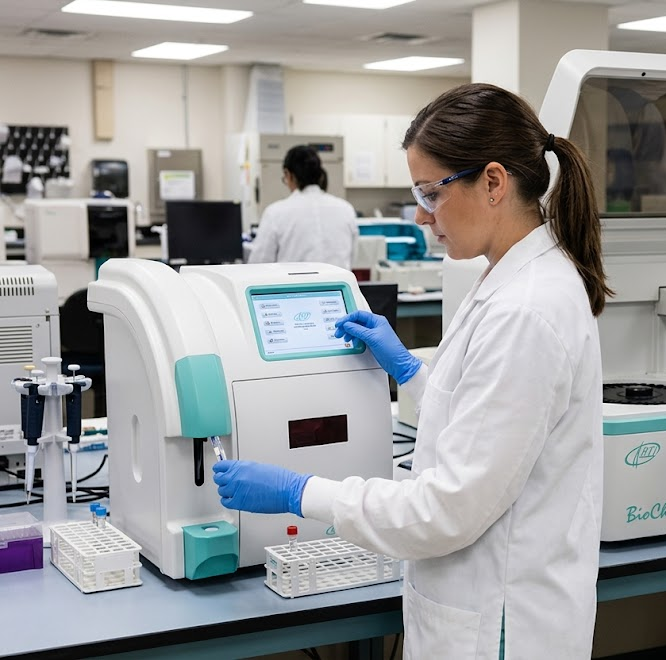
HTI's chemistry reagent menu covers all four: BUN (Urea Nitrogen), Creatinine, Uric Acid, and Microalbumin, with dedicated Microalbumin Control and Calibrator for full QC traceability on that assay. Running on the BioChem FC-120 at up to 100 tests per hour with full random access and STAT capability, a lab can run the complete renal panel alongside its routine workload without workflow disruption.
For the electrolyte component — Potassium, Sodium, Chloride, Calcium, and pH — the E-Lyte Plus has direct Ion Selective Electrode (ISE) measurement at 60 tests per hour with three speed modes (40s normal, 35s faster, 30s fastest) for operational flexibility. At 9.5 kg and 27.9 × 43.8 cm footprint, it sits on the bench alongside the chemistry analyzer without requiring dedicated space. The analyzer configuration covers K, Na, Cl, Ca, and pH — the full electrolyte profile relevant to CKD staging and dialysis preparation.
The chemistry + electrolyte combination gives the lab a complete renal workup — serology and ISE — from a two-instrument bench setup with a single reagent vendor relationship.
Why this workflow matters specifically in LATAM, ASEAN, and MENA
Across Latin America, dialysis program expansion is one of the fastest-growing segments of public health infrastructure investment — driven by the downstream cost of undetected CKD in the diabetic population. Chile, Colombia, Brazil, and Mexico have all expanded national renal programs in the last decade, but the upstream screening infrastructure at primary care hasn't scaled proportionately. Labs that can offer a systematic renal panel — not just a creatinine reflex — are positioned to serve both the clinical need and the growing tender requirements that accompany program expansion.
In ASEAN, CKD prevalence is particularly elevated in Thailand, Vietnam, and the Philippines, where diabetes and hypertension coexist with agricultural pesticide nephrotoxicity in rural populations. Mid-volume labs serving regional hospital networks in these markets represent the right deployment level for a chemistry + electrolyte renal workflow.
Across MENA, Gulf states with high diabetes prevalence — Saudi Arabia, UAE, Kuwait — are expanding nephrology and dialysis infrastructure. Reference labs and private hospitals in these markets are actively upgrading renal panel capability as nephrologist referral volumes increase.
Screening Opportunities
CKD is not going to become less prevalent in emerging markets. The risk factors driving it are entrenched — diabetes, hypertension, dietary patterns, and limited early-stage clinical intervention. What can change is how early the diagnosis is made. Labs that build systematic renal screening workflows now are positioned ahead of the clinical and procurement curve.
If you'd like to evaluate HTI's chemistry reagent menu or the E-Lyte Plus for a renal screening workflow in your market, our distributor partners can walk you through the configuration. Reach out — we'd value the conversation.
High Technology, Inc. — Massachusetts, USA
distributors@htidiagnostics.com | www.htidiagnostics.com